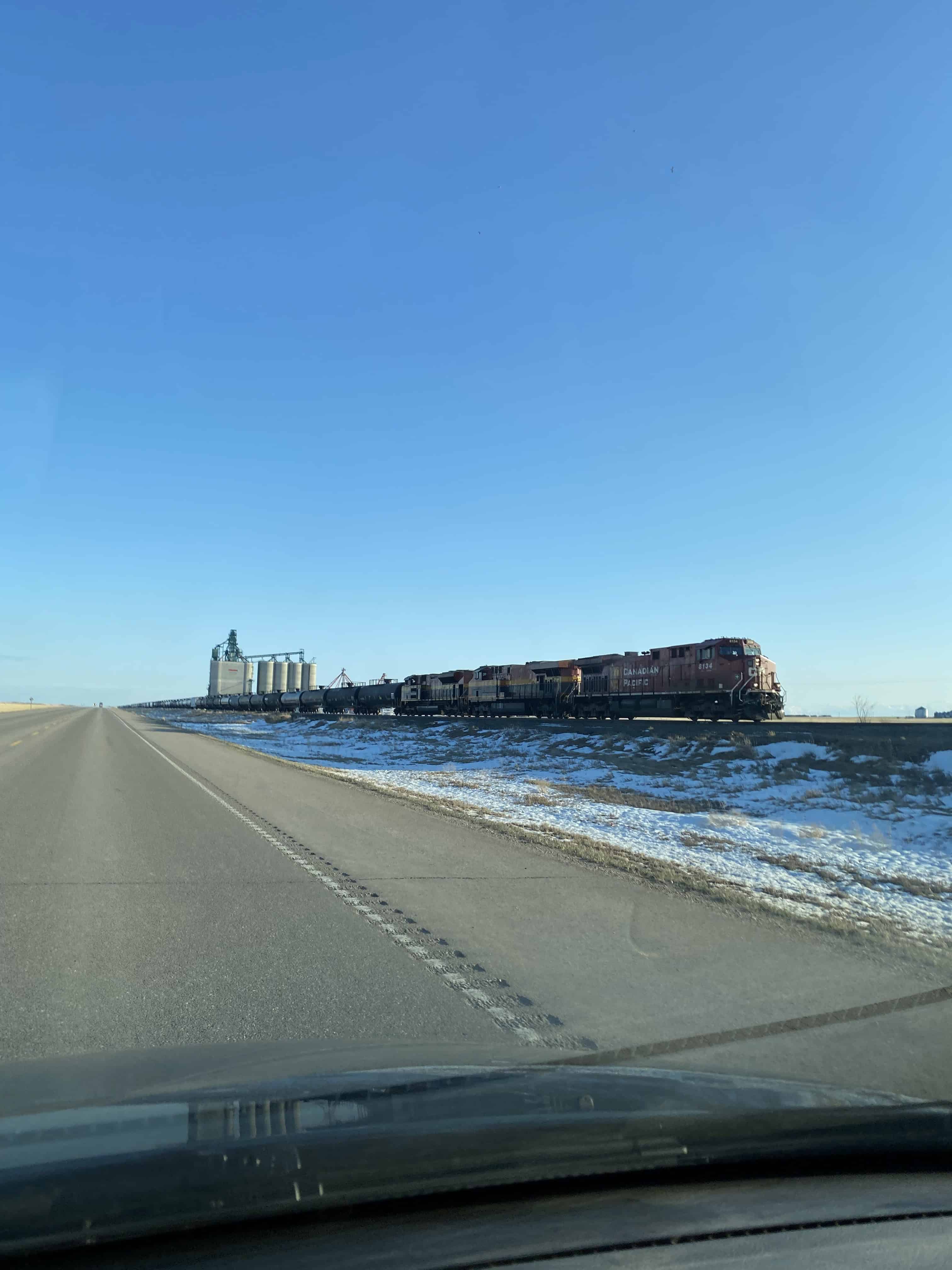
The Revenue Cap on Grain Rail: What the Maximum Revenue Entitlement Means for Prairie Producers
The Maximum Revenue Entitlement is the federal mechanism that limits how much money CN and CPKC can collect for moving grain across Western Canada. Most producers have heard the term. Few know what it does — or doesn’t — protect them from.
System Condition
The Maximum Revenue Entitlement (MRE) is a form of economic regulation established under the Canada Transportation Act. It does not set the price a producer pays to ship grain. It sets a ceiling on the total grain revenue each railway is permitted to collect across all its western grain movements in a crop year (August 1 to July 31). CN and CPKC each have a separate annual cap, calculated and enforced by the Canadian Transportation Agency (CTA).
The MRE replaced a previous system under which the CTA set maximum rates on individual shipments. The shift to a revenue cap was designed to give railways flexibility to price individual movements as they see fit — competing for traffic, adjusting for route and season — while preventing aggregate overcharging across the system as a whole. It is not a price guarantee. It is a revenue ceiling.
How the Cap Is Calculated
The CTA calculates each railway’s MRE after the crop year ends, using a formula anchored to a base year of 2000–2001. Three variables adjust the base figure upward or downward each year:
Volume. The more tonnes a railway moves, the higher its permitted revenue. The MRE is explicitly designed to scale with throughput — if CN moves 20 percent more grain than the prior year, its cap rises proportionally. This prevents the MRE from discouraging railways from accepting grain traffic.
Average haul distance. Longer average movements generate higher permitted revenue. The formula adds $0.022 per tonne for each mile the average haul exceeds the 2000–2001 baseline. As export corridors shift — for example, more grain moving to Prince Rupert or through CPKC’s extended network — average haul distances shift and the MRE adjusts.
Inflation (VRCPI). The CTA publishes a Volume-Related Composite Price Index (VRCPI) for each railway by April 30, before each crop year begins. The VRCPI reflects changes in railway input costs — labour, fuel, materials, and capital — and indexes the MRE to those costs. It is a railway-specific inflation measure, not the Consumer Price Index.
The CTA releases its annual MRE determination for each railway by December 31 following the close of the crop year.
Corridor Status
The MRE covers regulated western grain movements to British Columbia ports (Vancouver, Prince Rupert, and others listed under the Canada Transportation Act) and movements through Thunder Bay and Armstrong, Ontario. It applies to both CN and CPKC for any qualifying movement within Canada’s Western Division — defined as the region west of a line through Thunder Bay and Armstrong.
Cross-border movements destined for US export positions, and grain shipped in containers on flatcars, are not covered by the MRE. When basis economics draw Prairie grain toward US Pacific Northwest or Gulf export positions, those movements fall outside the cap entirely.
The practical corridor implication: the MRE’s protection applies most directly to the west coast bulk export corridor and the Thunder Bay corridor. It does not extend to movements that shift outside the regulated system.
What Happens When a Railway Exceeds Its Cap
If a railway’s actual grain revenue exceeds its MRE for the crop year, the CTA requires it to pay back the excess plus a penalty within 30 days. The penalty structure under the Canada Transportation Act is:
- Excess of 1% or less of the MRE: 5% penalty on the excess
- Excess greater than 1% of the MRE: 15% penalty on the excess
Payment goes to the Western Grains Research Foundation (WGRF), a farmer-directed organization that funds Prairie agricultural research. The money does not flow back to shippers or producers directly.
The most recent determination, issued by the CTA on December 19, 2025 (Determination No. R-2025-214), illustrates how the system works in a high-volume year. The 2024–25 crop year saw 49,002,694 tonnes of western grain moved by the two railways combined — a 12.1 percent increase over the prior crop year’s 43.7 million tonnes. CN’s grain revenue of $1,454,604,793 came in $5,913,453 below its entitlement of $1,460,518,246. CPKC’s grain revenue of $1,066,938,687 exceeded its entitlement of $1,064,278,437 by $2,660,250. CPKC’s overage fell within the 1% threshold, triggering a 5% penalty of $133,012, for a total payment to WGRF of approximately $2.8 million.
Producer Impact
The MRE constrains railway aggregate pricing power, but it does not guarantee any producer a specific freight rate. Railways retain full discretion over how they price individual movements — by route, season, car type, and customer — provided their total western grain revenue stays within the annual cap.
What the MRE does for producers, indirectly:
It limits the ceiling on aggregate freight costs embedded in basis. Country elevator basis reflects, among other factors, the cost of moving grain from the elevator to an export position. If railways could raise aggregate revenue without limit, that cost would flow through to basis. The MRE caps how far that can go at the system level.
It scales with volume, not against it. Record crop years — like 2024–25 — generate higher MREs automatically. The cap does not create an incentive for railways to restrict throughput to protect revenue. A railway that moves more grain is entitled to collect more revenue, up to its recalculated cap.
It does not protect against rate volatility within the cap. A railway can raise rates on one corridor, one commodity, or one season, provided it offsets that elsewhere to stay under the aggregate limit. Producers on routes where the railway faces less competition may see higher rates even in years when the railway stays within its MRE.
The penalty flows to grain research, not to producers. When a railway exceeds its cap, the excess and penalty go to WGRF. Producers benefit indirectly through research funding, but there is no refund mechanism to individual shippers.
Seasonal Context
The MRE recalculation is an annual event, with the determination released by December 31 each year. In high-volume crop years — when both railways are moving grain at or near capacity — the gap between actual revenue and the cap narrows. CPKC’s breach in 2024–25, during a year when system volumes rose 12.1 percent, illustrates the pressure record throughput places on revenue management. Producers should treat the annual MRE determination as a standing indicator of whether the freight cost environment is tightening or easing at the system level.
Cross-Reference to Related WFR Coverage
What to Watch
Annual MRE determination — Canadian Transportation Agency, released by December 31 each year. The key indicators: whether either railway exceeded its cap, the size of any overage relative to the cap, and the year-over-year change in total western grain volumes moved. Source: Canadian Transportation Agency — Western Grain MRE Program (annual).
VRCPI announcement — CTA publishes the Volume-Related Composite Price Index for each railway by April 30, before each crop year begins. A rising VRCPI means railways can collect more revenue per tonne before hitting the cap. Source: Canadian Transportation Agency (annual, April).
Total western grain volumes moved — reported in the annual MRE determination. Volume is the primary driver of MRE size. A crop year that moves significantly more grain than forecast will push railways closer to their caps. Source: Canadian Transportation Agency (annual, December).
Quorum Corporation grain transportation monitor — monthly system performance data, including car supply, velocity, and terminal dwell times. Rail system performance drives the volume base that underlies each year’s MRE. Source: Quorum Corporation (monthly).
Tags: maximum revenue entitlement, MRE, CN Rail, CPKC, grain freight rates, Canadian Transportation Agency, western grain transportation, Prairie basis, grain rail regulation, Western Grains Research Foundation
Unfamiliar with grain transportation terminology? See the WFR Transportation Glossary for definitions of key terms used in this post.
This post was produced with AI assistance. All sources are attributed and linked. Western Farm Report editorial standards apply.