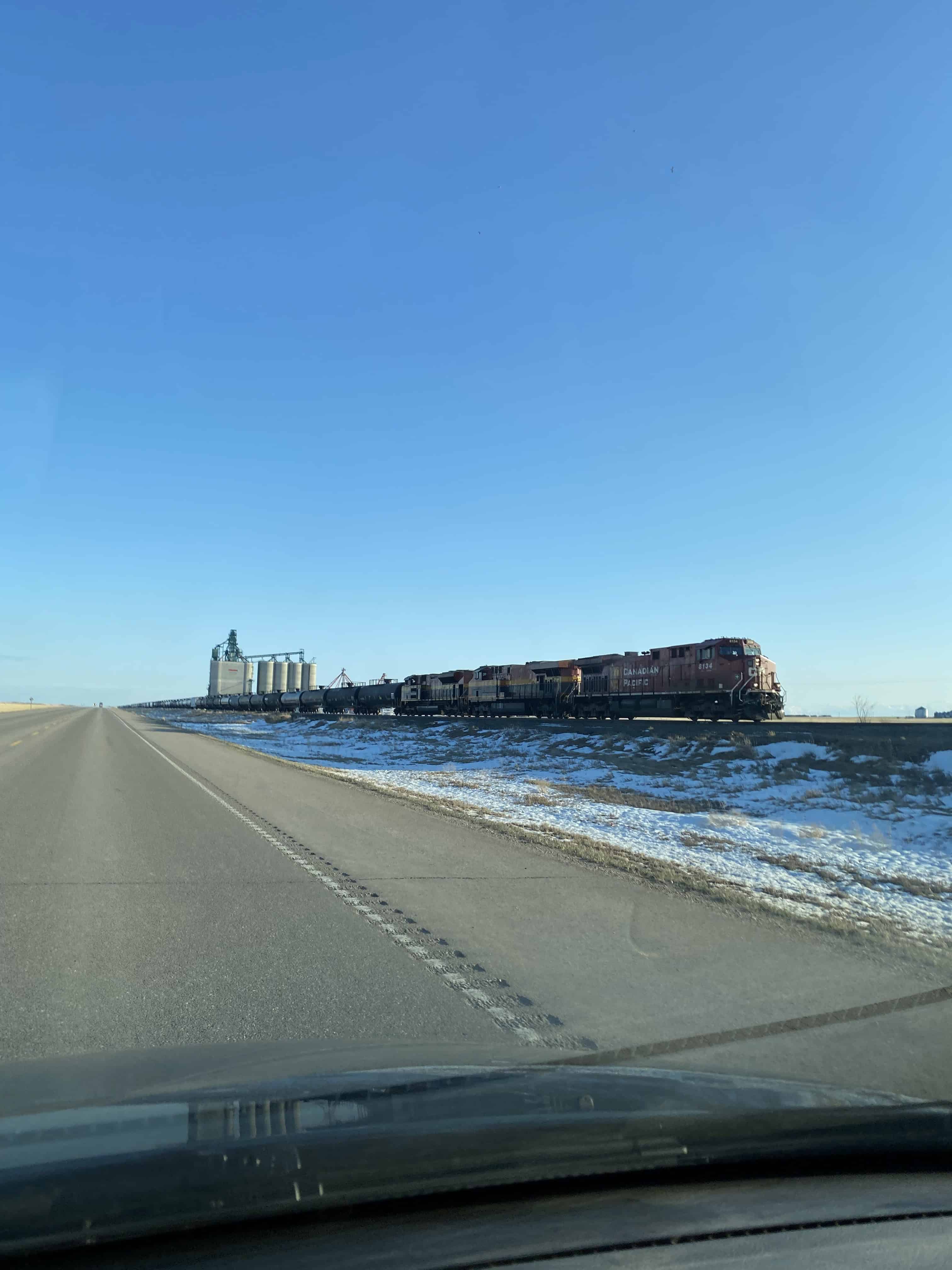
Vancouver Vessel Lineup Hits 37 as Canola Export Surge Strains West Coast Terminal Capacity
System Condition
A demand-driven volume acceleration is the structural condition now pressing against west coast export infrastructure. The March 1, 2026 reset of Chinese import duties on Canadian canola — effective duty on canola seed reduced to 14.9% from a prohibitive 75.8% provisional rate; separate tariffs on canola meal suspended to zero through December 31, 2026 — unlocked significant latent Chinese buying. Loading at Vancouver and Prince Rupert accelerated sharply in the final weeks of February as shipments were front-run ahead of the tariff transition date.
That surge has not dissipated. It has merged with the structural backdrop of a record Prairie harvest: Statistics Canada’s estimate for 2025 field-crop production in Western Canada stands at 85.4 MMT, a 15.6% increase from 2024 and the largest on record, according to the Quorum Corporation Grain Monitoring Program February 2026 report. Total grain supply for the 2025-26 crop year — production plus carry-forward stocks — is estimated at 92.0 MMT, also a record. The system is being asked to move unprecedented volume at the same moment that one of its two largest export markets has re-entered the market at scale. Infrastructure stress is the predictable result.
Corridor Status
Vancouver
The Vancouver vessel lineup stood at 37 vessels as of grain Week 37 (week ending April 19, 2026), according to the Quorum Corporation Grain Monitoring Program Weekly Performance Update for Week 36 — the most recent public data available. Of those 37 vessels, 9 were at berth actively loading, 14 were anchored at English Bay, 2 at Burrard Inlet, and 12 off Vancouver Island. The one-year average lineup at Vancouver is 20 vessels. At 37, the current lineup is 85% above that average and firmly in the significant-congestion range by Quorum benchmarks (30+ vessels).
Vancouver terminal storage is at 104% of working capacity — the terminal elevator network is operating above its design storage ceiling, with no buffer remaining. Weekly port unloads at Vancouver for Week 36 were 8,322 cars, 17% above the same week last year and 19% above the 4-week moving average. Terminal out-of-car time (OCT) at Vancouver was 6.3% for Week 36 — moderate and not itself a bottleneck signal, indicating that when cars do arrive, terminals are unloading them efficiently. The binding constraint at Vancouver is not unloading speed but vessel queue depth: with 37 ships waiting for berths, average time in port is extending, and demurrage exposure is increasing for cargo that arrived on contracted loading windows.
Year-to-date Vancouver shipments through Week 36 stand at 23,123,000 tonnes, 8% above the same period last year and 8% above the 3-year average.
Prince Rupert
Prince Rupert presents a different stress pattern. The vessel lineup of 4 at Week 37 is only marginally above the one-year average of 3 vessels — vessel queue congestion is not the primary issue here. The concern is terminal out-of-car time: Prince Rupert OCT reached 40.2% in Week 36, meaning the terminal was without railcars to unload for 40% of its operating hours. That figure indicates cars are arriving in bursts rather than in a steady flow, consistent with the acceleration in CN service loading to Prince Rupert from Prairie origins. When OCT runs this high, unload capacity is being intermittently idled while the terminal waits for the next train set — a throughput inefficiency that slows the pace at which vessels can be turned around and returned to loading.
Prince Rupert Grain terminal’s sailing-distance advantage of approximately 1,100 km over Vancouver to major Asian ports gives it a structural edge for time-sensitive canola shipments to China. That advantage is being exercised, but the OCT figure suggests the terminal is processing volume in an uneven pattern that limits its throughput efficiency.
Year-to-date Prince Rupert shipments through Week 36 stand at 3,664,300 tonnes, 2% above the same period last year and 15% above the 3-year average.
Rail — CN and CPKC
Rail performance through February 2026 was strong by recent historical standards, providing meaningful context for interpreting the vessel lineup. Car cycle time to western ports averaged 13.0 days in February and 13.2 days year-to-date — down 9.8% from the same period a year earlier, according to the Quorum February monthly report. Loaded transit time to western ports averaged 5.6 days in February (5.4 days YTD), down 13.1% year-to-date. The hopper-car fleet had 96% of cars deployed in February (19,676 cars in service). No active labour disruptions are present on either network as of the date of this post.
The vessel lineup buildup at Vancouver is therefore not being driven by a rail service failure. Cars are moving to port at above-average velocity. The constraint is port-side absorption capacity: 37 vessels are competing for a finite number of grain terminal berths, and storage behind those berths is at capacity. The system bottleneck has shifted from the rail corridor to the port terminal interface.
Ocean Freight
The Baltic Dry Index reached 2,484 points on April 16, 2026 — a four-month high — before easing to 1,780 points in the April 18 session, according to Baltic Exchange data. The Baltic Panamax Index stood at 1,612 points as of April 18, with the P5TC 5-route average at US$14,504 per day. Panamax vessels (60,000–80,000 DWT) are the primary vessel class for Canadian canola exports to China. At current Panamax rates, ocean freight costs remain elevated relative to early-2026 levels, which embeds additional freight cost into the basis spread producers face at country elevators.
Producer Impact
The vessel lineup at Vancouver has direct basis implications for Prairie canola producers, particularly those in central and northern Alberta and Saskatchewan whose grain moves primarily to Vancouver via CPKC.
When 37 vessels are queued at anchor, average vessel time in port extends — Quorum reported 12.1 days average vessel time in port for February, already up from 11.2 days in January. As that average rises further under the current lineup, terminal operators face increasing demurrage pressure, which flows back through the basis structure. Basis at Vancouver-positioned country elevators will tend to weaken as port congestion costs increase and terminal handling margins compress.
The storage situation compounds this. With Vancouver terminal stocks at 104% of working capacity, country elevators delivering into the Vancouver corridor have limited ability to push additional volume into the terminal system until vessels clear. This creates a backup pressure: country elevator stocks — already at 82% of working capacity system-wide as of Week 36 — cannot draw down as quickly as producers need to deliver. Alberta country stocks were at 85% of working capacity in Week 36, Saskatchewan at 78%.
The canola marketing window opened by the tariff reset is genuine, but the pace at which that window can be cleared is constrained by terminal capacity. Producers with unpriced canola should factor port absorption capacity into their delivery timing. The current lineup suggests no immediate relief in Vancouver basis; the more relevant question is whether the lineup normalizes before the spring road weight restriction period tightens farm-to-elevator movement, typically late March through May in Alberta and Saskatchewan.
Prince Rupert offers a partial alternative routing for producers whose grain is moving via CN, but Prince Rupert’s OCT signal suggests its throughput is also irregular. The Prince Rupert corridor’s relative advantage — shorter sailing time to China — may be partially offset by uneven car supply to the terminal.
Canola oil remains subject to full Chinese import tariffs; the marketing window created by the March 1 reset applies to canola seed and canola meal, not oil. Domestic crush margins remain strong and crush capacity is expanding, providing an alternative demand pathway for producers who cannot access the export channel at competitive basis levels.
Seasonal Context
The 37-vessel lineup at Vancouver is the highest since the post-harvest peak congestion periods documented in Quorum’s recent crop year tracking. For comparison, Quorum noted in its April 2025 commentary that a lineup of 47 vessels at the west coast occurred during the 2024-25 crop year’s worst congestion period — the current figure is elevated but has not yet reached that level.
YTD western port shipments of 31.2 MMT through Week 36 are 6% above the same period last year and 8% above the 3-year average, consistent with the record supply backdrop. The February 2026 Quorum report notes that bulk grain shipments from western ports through the first seven months of 2025-26 were 5.3% above the same period last year. The system is moving more grain than in any recent comparable period, which makes the current lineup a capacity-pressure story, not a performance-failure story — but the distinction matters less to producers waiting for basis to recover.
The St. Lawrence Seaway system was closed during February and Thunder Bay reported no vessel clearances during that month. The Seaway’s annual spring reopening — typically late March — redirects some Prairie grain volume eastward and should begin to reduce pressure on the west coast corridor as the crop year progresses. Thunder Bay unloads for Week 36 were 2,134 cars, 45% above the 4-week moving average, consistent with post-reopening catch-up movement.
Cross-Reference to Related WFR Coverage
What to Watch
Vancouver vessel lineup — weekly, Quorum Corporation Grain Monitoring Program. Watch for the lineup to clear below 20 vessels as the signal that terminal capacity pressure has normalized. Any sustained reading above 30 vessels into May would indicate structural congestion persisting into the late crop year — a basis-negative condition for producers still holding canola.
Prince Rupert out-of-car time — weekly, Quorum Corporation Grain Monitoring Program. The 40.2% OCT reading for Week 36 is the metric to watch on the Prince Rupert corridor. A return to the 10–15% range would signal that car delivery to the terminal has normalized and throughput efficiency is recovering.
Canadian Grain Commission weekly canola export data — weekly, Canadian Grain Commission Grain Statistics Weekly. Weekly canola shipment volumes and port receipts will indicate whether Chinese buying has sustained above pre-tariff-reset levels or whether the February surge was primarily a front-running event. Sustained elevated weekly shipments confirm ongoing demand; a return to pre-reset pace would relieve port congestion more quickly.
Baltic Panamax Index — daily, Baltic Exchange. The P5TC average at US$14,504/day as of April 18 represents elevated freight cost embedded in canola export economics. Any significant further increase in Panamax rates would widen the freight cost component of Prairie canola basis, reducing the net price producers receive at country elevators despite the tariff reset improving market access.
Unfamiliar with grain shipping terminology? Visit the WFR Transportation Glossary for terms and definitions.
This post was produced with AI assistance. All sources are attributed and linked. Western Farm Report editorial standards apply.