Rail Throughput Records Mask Persistent Car Shortfall as CN Contract Clock Ticks Down
System Condition
The Prairie grain transportation system in May 2026 is running at record throughput and simultaneously failing to meet car supply targets — a contradiction that matters more than either number taken alone.
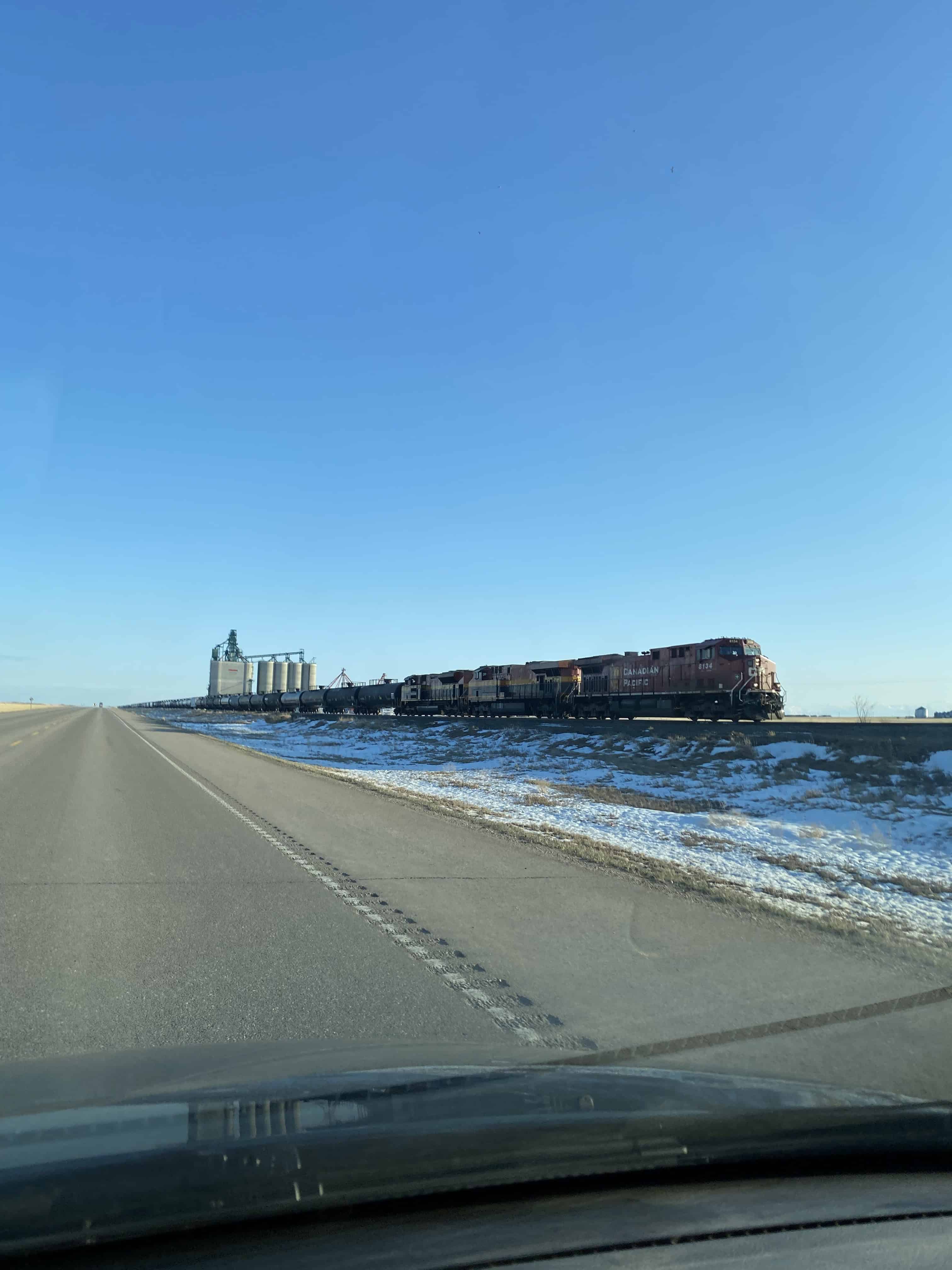
CPKC’s April 2026 performance was its best April on record: 2.9 million metric tonnes of Canadian grain and grain products moved in 30,381 carloads, surpassing the previous April record set in 2020. CN matched it, hauling 3.2 million metric tonnes in April — also a monthly record. CPKC’s first quarter of 2026 (7.2 MMT) set a new record quarter. CN has now posted eight consecutive months of strong performance in the current crop year, seven of which set monthly records. These are not routine numbers. They reflect sustained high-intensity operation across both rail corridors.
Against that backdrop, hopper car fulfillment has sat below the 90% performance threshold for fourteen consecutive weeks. Ag Transport Coalition data for Week 38 (ending May 4, 2026) shows CN and CPKC combined supplying 85% of cars ordered — CN at 88%, CPKC at 81%. The 90% threshold is the operational benchmark used by the grain handling industry to assess whether car supply is meeting shipper demand. Being below it for fourteen straight weeks, while simultaneously posting record tonnage, points to a structural mismatch: the system is moving more grain than it ever has, but it is not keeping pace with what shippers are ordering.
The likely explanation is a tight car cycle. When car volumes are at record levels, cycle times lengthen — cars take longer to move from country elevator to port and back because the system has less slack to absorb bottlenecks at terminal elevators and loading berths. A longer cycle time means fewer cars available per week at country elevators even when the total number of carloads is high. CPKC flagged this dynamic explicitly in its April statement, noting that volumes in multiple weeks exceeded average supply chain capacity targets and calling on all supply chain participants — specifically including customer loading facilities and terminal operators — to operate at full capacity to sustain throughput.
The Canadian Transportation Agency confirmed the 2026–2027 Volume-Related Composite Price Index (VRCPI) at 1.9864 on May 6 — the index used to calculate CN’s and CPKC’s Maximum Revenue Entitlement for the coming crop year beginning August 1. The index rose 0.65–0.66% over the prior year for CN and CPKC respectively, a modest inflationary adjustment that has no direct effect on country elevator basis but confirms the regulatory framework governing grain freight revenue is functioning normally.
Corridor Status
West Coast — Vancouver and Prince Rupert
Both west coast export terminals are operating without labour disruption. The BCMEA and ILWU reached a ratified four-year collective agreement in June 2025, covering more than 7,400 longshore workers and foremen at British Columbia ports, effective April 1, 2023 through March 31, 2027. The agreement ended two years of intermittent disruption that included multiple strike notices, a November 2024 lockout, and binding arbitration imposed by the federal Labour Minister. The agreement runs for nearly two more years and removes port labour disruption from the near-term risk register for the west coast corridor.
Vancouver Fraser Port Authority data shows container vessel operations are running normally. Grain terminal operations at Vancouver — including Richardson International, Cascadia (Bunge/Richardson), G3, Alliance Grain Terminal (Parrish & Heimbecker/Paterson/North West Terminal), Cargill, and Pacific Elevators — are receiving rail cars from both CN and CPKC and loading vessels without reported operational disruption. CPKC’s service plan data indicates rail cut-off schedules into Vancouver are being maintained.
At Prince Rupert, Prince Rupert Grain Terminal continues to operate as the primary north coast export position, with CN as the primary rail carrier. The 1,100 km sailing distance advantage to Asian markets relative to Vancouver remains intact and relevant given current Panamax rate levels.
Rail — CN and CPKC
Labour peace at both railways is confirmed and documented. CN’s arbitrated collective agreement with the Teamsters Canada Rail Conference (TCRC) — covering approximately 6,000 conductors, yard coordinators, and locomotive engineers — runs from January 1, 2024 through December 31, 2026, with 3% annual wage increases. CPKC’s arbitrated agreement with the TCRC covers approximately 3,200 train and engine workers and 80 rail traffic controllers through December 31, 2027, also at 3% annually. Neither agreement required ratification by the union.
The absence of near-term labour risk at the railways is real, but the CN agreement’s December 31, 2026 expiry means a new bargaining cycle is approaching. Given the pattern from the 2024 dispute — contracts at both railways expired simultaneously in December 2023, leading to a coordinated strike and lockout in August 2024 before binding arbitration was imposed — producers and grain companies have reason to watch CN bargaining developments in the second half of 2026. The CPKC agreement running to 2027 provides some buffer, but a CN disruption at peak harvest 2026 would not be buffered by CPKC alone.
Thunder Bay and Great Lakes–St. Lawrence Corridor
The St. Lawrence Seaway has reopened for the 2026 navigation season, restoring the Thunder Bay corridor for movement to European, North African, and eastern markets. The Thunder Bay corridor is functioning as a seasonal pressure release valve for the west coast system. Producers moving durum, hard red spring wheat, or specialty grains to European destinations should be monitoring Thunder Bay basis alongside Vancouver basis as the two corridors compete for volume.
Ocean Freight
The Baltic Dry Index closed at 2,991 on May 6, 2026 — up from 1,882 at the start of January and recovered sharply from mid-January lows near 1,608. The Baltic Panamax Index (BPI) reached 2,135 points on May 6, with average daily Panamax earnings of $19,216 — up from $17,638 the prior week. Supramax earnings on May 6 were $19,136 per day.
These are meaningful numbers for Prairie producers. Panamax vessels in the 60,000–80,000 DWT range are the primary carriers of Canadian grain exports. When Panamax daily earnings rise, charter rates on routes from Vancouver to Japan, China, and Southeast Asia increase in parallel. That cost is embedded in the basis grain companies offer at country elevators — they cannot absorb freight cost increases without adjusting what they pay producers. The direction of Panamax rates since January is upward, and the recent acceleration in the first week of May reflects strengthening demand. Unless rates retreat, the freight component of Prairie elevator basis is under upward pressure.
Producer Impact
The practical implication of the current system state sits at the intersection of three variables: record throughput, a persistent car shortfall, and rising ocean freight.
Record throughput means the system is moving grain aggressively, which is positive for producers who have grain at licensed elevators waiting to move. The incentive for country elevator operators to keep receival windows open is real when the system is performing at record capacity.
The car shortfall complicates that picture. At 85% combined fulfillment, one in six cars ordered is not arriving. For producers on tight storage or with priced positions requiring delivery, a missed car order is not an abstraction — it is a direct operational constraint. Country elevators operating with full bins and incomplete car supply will reduce or halt receival, forcing producers to hold grain on farm longer than planned. Producers who are not priced and are holding grain on farm with adequate storage are less exposed to the car shortfall than those with committed delivery positions.
The freight cost issue is directional. Rising Panamax rates widen the transportation cost embedded in basis. A Panamax at $19,216/day costs more to charter than the same vessel at $17,000/day, and that difference is distributed across the tonnes loaded. For canola and wheat destined for Asian markets through Vancouver and Prince Rupert, the freight cost movement since January is a basis headwind. Producers who priced grain early in the crop year when ocean freight was lower locked in basis before this freight cost increase. Those pricing now are pricing into a wider freight differential.
The CN contract expiry in December creates a forward risk that is not imminent but is real. The 2024 dispute demonstrated that even a brief rail shutdown — less than 24 hours before government intervention — imposes system recovery costs that persist for weeks. A CN bargaining failure in late 2026 that coincides with fall harvest would replicate the worst-case scenario from 2024. Producers making delivery timing or marketing decisions for the 2026-27 crop should be aware that the CN labour horizon adds uncertainty to the October–December 2026 movement window.
Seasonal Context
The current crop year has been exceptional by historical standards. CPKC’s Q1 2026 throughput of 7.2 MMT beat the previous record quarter set in Q1 2021. CN’s eight consecutive months of strong performance and seven monthly records represent sustained system output above historical norms. The scale of the 2025 harvest — described by both railways as a record crop driving record demand — is the primary driver. The system is moving more grain because there is more grain to move.
The persistent car shortfall, viewed against this context, is less alarming than it might appear in isolation. The shortfall is not the result of railway equipment failure or capacity contraction — it appears to reflect cycle time extension under maximum throughput conditions. Nevertheless, fourteen consecutive weeks below the 90% fulfillment threshold is a significant sustained miss, and it signals that car supply is not expanding as fast as grain demand is growing. The Quorum Corporation’s monthly Prairie Grain Transportation Monitor will provide the definitive assessment of car supply performance against ordered demand for the current crop year when the next edition is released.
The Panamax rate context is also worth noting. The BPI at 2,135 on May 6 is materially above the January range of 1,282–1,670 that characterized the first six weeks of 2026. Whether this reflects seasonal strengthening, specific commodity demand shifts, or a broader dry bulk market tightening is a question the Baltic Exchange route-specific data can help answer, but the directional trend is clear.
Cross-Reference to Related WFR Coverage
Asia Intel — Canadian Grain Export Commitments and West Coast Throughput Conditions
Crop Reports — Prairie Elevator Storage Pressure and Car Supply Conditions
European Markets — Thunder Bay Corridor Status and Canadian Wheat Movement to Europe
What This Means For You
The headline telling you railways are moving record grain is accurate, and it matters — but it is not the complete picture for a producer making delivery or pricing decisions right now.
If you have priced grain committed to delivery and you are relying on country elevator receival to complete that commitment, the car shortfall is your most immediate operational risk. At 85% combined fulfillment, one order in six is not being filled on schedule. If your elevator is running close to capacity and your delivery window is tight, that gap has a direct effect on whether you get your grain moved when you planned. Talk to your elevator contact now about receival availability and car order timelines rather than assuming record system throughput translates to an open receival window for your position.
If you are unpriced and holding grain on farm with adequate storage, the current system state creates a choice between two unfavorable trends: a rising freight cost environment that is widening basis for Asian-destination canola and wheat, and a CN labour horizon in December that adds uncertainty to fall harvest movement. Neither trend points to basis improving materially before the new crop year. Producers who have priced new crop positions at current basis levels have already locked in before the freight cost acceleration of April–May. Those who have not are pricing into that headwind.
The CN contract expiry deserves more attention than it is currently getting. The 2024 dispute cost the agricultural sector an estimated $40–50 million per day during the stoppage, and the system took weeks to recover throughput after the brief shutdown. A repeat scenario in October or November 2026 — when both new crop delivery pressure and carry-out sales obligations are at their highest — would impose costs significantly larger than a disruption at any other point in the crop year. Watch for CN and Teamsters bargaining developments beginning in the third quarter. When notice to bargain is served, that is the trigger to start thinking about delivery timing for fall grain movement.
What to Watch
Quorum Corporation — Prairie Grain Transportation Monitor (monthly): The next release will provide the definitive car supply fulfillment data, train velocity, and terminal dwell time assessment for the current period. This is the Tier 1 benchmark for system performance. Monitor the Quorum Corporation website for the next monthly release.
Ag Transport Coalition weekly car supply data: Week-by-week fulfillment tracking against the 90% threshold. If combined fulfillment drops below 80% for two consecutive weeks, elevator storage pressure at country positions will intensify and receival restrictions are likely.
Baltic Panamax Index — Baltic Exchange (daily): Track the BPI trajectory through May and June. A sustained move above 2,200 points will begin to show materially in country elevator basis for canola and wheat bound for Asian export markets. Conversely, a pullback toward 1,800 would ease the freight cost headwind.
CN Rail — Teamsters Canada Rail Conference bargaining (Q3 2026 onwards): The CN collective agreement expires December 31, 2026. Monitor Transport Canada and the Canadian Transportation Agency for any regulatory developments related to the next bargaining round. The Canadian Industrial Relations Board’s treatment of rail labour under the Canada Labour Code — and the federal government’s willingness to impose binding arbitration — will be the key variable determining whether a 2024-style disruption risk materializes.
Tags: CN Rail, CPKC, hopper car supply, Baltic Panamax Index, vessel lineup, Vancouver grain terminal, Prince Rupert Grain Terminal, Teamsters Canada Rail Conference, grain transportation basis, Maximum Revenue Entitlement
Unfamiliar with grain transportation terminology? See the WFR Transportation Glossary for definitions of key terms used in this post. Note: The “#” placeholder must be replaced with the live WFR Transportation Glossary URL once the page is built — this is a pending website development task.
This post was produced with AI assistance. All sources are attributed and linked. Western Farm Report editorial standards apply.
Link Check Note for Editor:
- Quorum Corporation – grainmonitor.ca
- Vancouver Fraser Port Authority portvancouver.com/port-operations/supply-chain/port-insights — confirmed active as of May 7, 2026
- Prince Rupert Port Authority rupertport.com — verify vessel lineup data page URL before publication
- Baltic Exchange balticexchange.com — confirm current BPI data page URL before publication