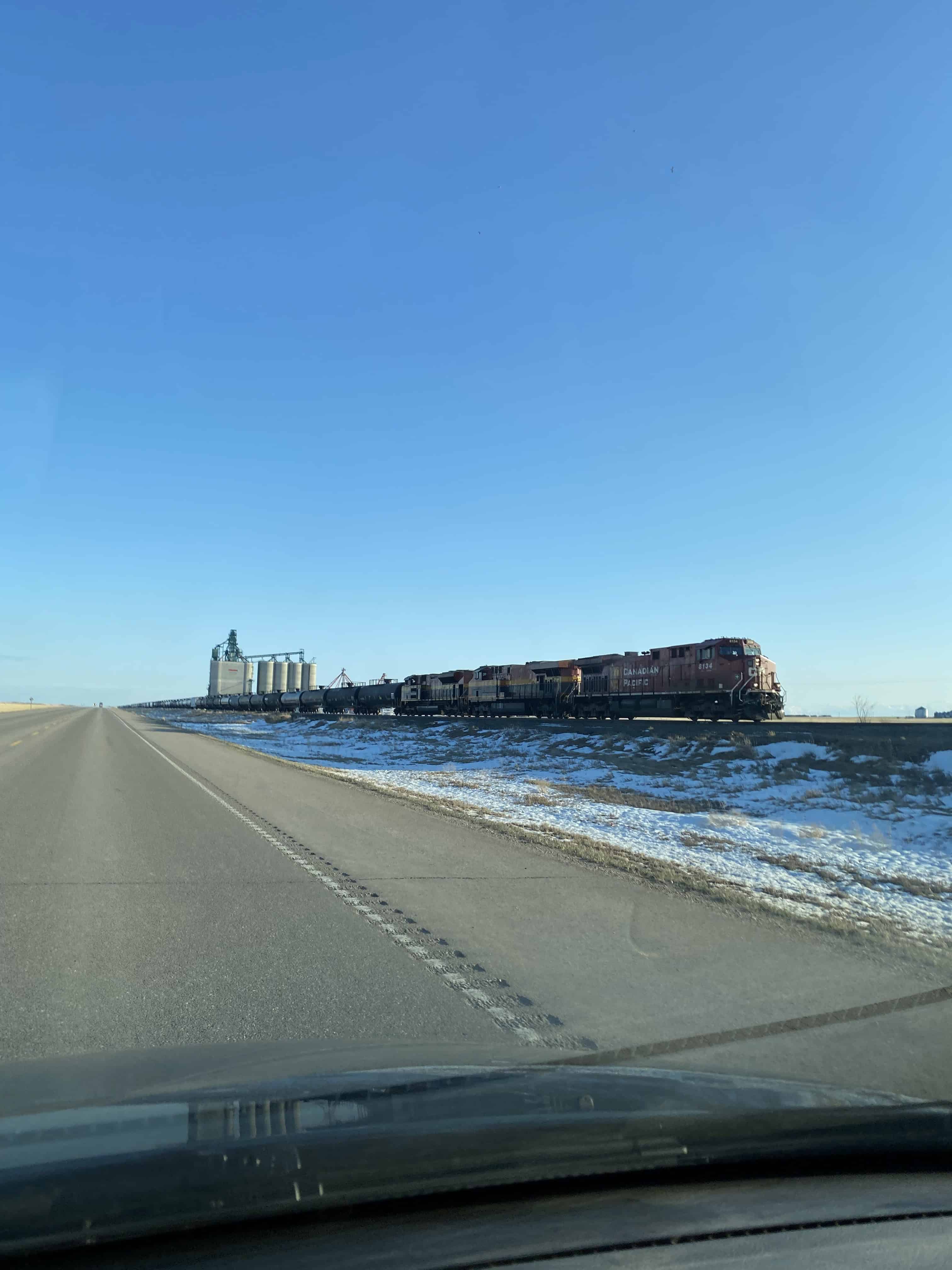
Prairie Rail: Record Wheat Volumes, Canola Collapse, and a Regulatory System Under Pressure
Western Farm Report | Rail Transportation Analysis
For the week of April 17, 2026
Canadian railways moved more Prairie wheat in 2025 than in any year in recent memory. Wheat carloadings reached 31.1 million tonnes for the full year — a 14.3 percent increase over 2024, and the largest annual gain in cereal grain shipments since 2018. That number looks strong on a spreadsheet. For producers still sitting on canola they can’t move at a reasonable price, it tells only half the story.
The same rail network that posted record wheat volumes also presided over a 12.4 percent collapse in canola carloadings, dropping from 10.0 million tonnes in 2024 to 8.8 million tonnes in 2025. Statistics Canada attributed the decline directly to trade tensions with China. The divergence — record grain volumes in one commodity, a multi-year low in another — captures the state of Prairie rail transportation heading into the 2025–26 crop year.
Record Volumes, but Not for Everything
Total freight moved by Canadian railways in 2025 came in at 376.6 million tonnes, down just 0.2 percent from 2024. Statistics Canada described the year as one where a bumper harvest and strong global demand kept grain shipments robust enough to offset sharp declines in freight received from American rail connections — which fell 13.3 percent year over year to 39.3 million tonnes, the lowest annual level since 2020.
Wheat was the anchor of that story. Monthly carloadings grew year over year in every month of 2025 except February, with double-digit gains in most months. The September figure alone was up 18.1 percent — 450,000 additional tonnes compared to September 2024. Other cereal grains followed the same trend, posting 23.4 percent annual growth to 7.8 million tonnes, the largest increase in that category since 2018.
Behind those numbers is a 2025 wheat crop that Statistics Canada projected would grow on higher yields across the Prairies. That production translated directly into rail demand, and the railways — despite a winter that by CN’s own account saw nearly double the number of days requiring safety-critical train length and speed restrictions compared to the previous year — largely kept pace.
Canola: The Trade-Driven Disruption
Canola is a different situation entirely, and it did not improve as the crop year progressed. In August 2025, canola carloadings hit 297,000 tonnes — the lowest monthly total in three years. At that point, canola represented just 1.3 percent of total non-intermodal rail traffic, down from 4.5 percent in August 2024. Statistics Canada reported that Canadian exports of canola fell from $660 million in August 2024 to $354 million in August 2025, a 46.5 percent decline. China’s share of those exports dropped from 75.5 percent to 25.0 percent in a single year.
China imposed a steep tariff on Canadian canola in 2025, and the impact moved immediately through the supply chain. Inland elevators faced reduced demand for delivery appointments. Basis levels shifted. Rail car orders for canola corridors — particularly Vancouver and Prince Rupert — declined not because of service failure but because the demand for export-bound canola dried up. This is a different problem than the car rationing crisis of 2024–25, but the outcome at the elevator level looks similar: less movement, more uncertainty.
The year-to-date canola rail shortfall through August 2025 exceeded half a million tonnes compared to the same period in 2024. With as much as 90 percent of Canadian canola production destined for export, and China having represented the dominant buyer, the structural gap left by that market shift will take time to fill — regardless of what the railways do.
Service Performance: A Mixed Record
The 2024–25 crop year closed with 49.0 million tonnes of Western grain moved — a 12.1 percent increase over the previous year’s 43.7 million tonnes. The Canadian Transportation Agency confirmed this in its December 2025 revenue entitlement determination. That volume record came with service problems embedded in it.
During the winter and spring of 2024–25, CN rationed more than 12,000 shipper orders, including over 8,600 in a roughly two-and-a-half month stretch. CPKC carried a backlog of rail car orders averaging 4,000 cars per week over four consecutive weeks, peaking at 4,600 — equivalent to a full week’s demand. CN’s car fill rate ran at roughly 56 percent of ordered cars during peak rationing periods. CPKC’s rate over the same stretch averaged 41 percent across four weeks. Vancouver and Prince Rupert corridors absorbed the worst of it.
The railways attributed part of the disruption to an exceptionally difficult winter. The 2025–26 grain plans released by both CN and CPKC in the summer of 2025 acknowledged these pressures. CN projected capacity to move up to 744,000 metric tonnes per week outside of winter and 595,000 tonnes per week in winter. CPKC projected weekly capacity of up to 685,000 metric tonnes when the Port of Thunder Bay is open. Whether those targets prove achievable depends on crop volume, weather, and the trade environment — factors neither railway controls.
Revenue Entitlements: The Regulatory Scorecard
Under the Canada Transportation Act, the Canadian Transportation Agency sets annual Maximum Revenue Entitlements for CN and CPKC on Western grain movements. The system limits total grain revenue rather than individual freight rates, with penalties flowing to the Western Grains Research Foundation when a railway exceeds its cap.
For crop year 2024–25, CN came in at $1,454,604,793 — approximately $5.9 million below its entitlement of $1,460,518,246. CPKC landed at $1,066,938,687, exceeding its cap of $1,064,278,437 by $2.66 million. CPKC was required to remit the excess plus a five percent penalty of $133,012 to the Western Grains Research Foundation within 30 days of the December 2025 determination.
For the 2025–26 crop year beginning August 1, 2025, the CTA set the Volume-Related Composite Price Index at 1.9734 for CN and 1.9349 for CPKC. These represent increases of 1.72 percent and 3.11 percent respectively over the prior year, reflecting higher forecasted input costs for labour, fuel, and capital. The VRCPI adjustments move the entitlement ceiling upward, giving both railways slightly more room before penalties apply. Whether that translates to meaningful rate relief for shippers at the elevator level depends on individual contract terms — the entitlement caps total revenue, not specific rates.
Interswitching: The Pilot That Expired
One of the more consequential rail policy changes of the past two years was also one of the shortest-lived. The federal government’s 2023 budget enabled an 18-month pilot project extending the interswitching distance in the Prairie provinces to 160 kilometres. The purpose was to inject competition into a system where 97 percent of licensed primary elevators sit on a single rail line, leaving them captive to one carrier. Under standard regulations, interswitching allows shippers to hand traffic off to another railway at a point where the lines connect — but only within prescribed distance zones ranging from 6.4 to 40 kilometres.
The extended pilot gave inland elevators within 160 kilometres of an interchange the ability to seek service from an alternate carrier. Grain shippers and elevator operators used it. The pilot ended in March 2025. Parliamentary prorogation in early 2025 made it impossible to pass legislation extending the program before the deadline, and the distance reverted to standard thresholds.
The Canadian Transportation Agency launched a statutory five-year review of the Railway Interswitching Regulations in November 2024. The CTA issued its determination in March 2026, addressing two core questions: what traffic qualifies for regulated interswitching and what factors should govern rate-setting. A further consultation on commercial market factors in rate-setting was initiated in November 2025, with first-phase submissions due in early 2026. The outcome of that process will shape whether future interswitching policy reflects shippers’ competitive access goals or railways’ cost-based rate arguments.
US Traffic: The Quiet Collapse
While grain headlines dominated, a parallel deterioration in US-connected rail traffic has received less attention. Freight received from American rail connections fell year over year for 11 consecutive months through December 2025. For the full year, US-connected tonnage dropped 13.3 percent — from roughly 45.3 million tonnes in 2024 to 39.3 million tonnes in 2025, the lowest level since the COVID disruptions of 2020.
The decline reflects the trade friction running both ways: US tariffs on Canadian goods and Canadian counter-tariffs on American goods. In May 2025, Canadian imports from the US by rail fell 34.0 percent year over year. Exports to the US by rail were down 16.8 percent in the same month. This matters for producers who depend on cross-border commodity flows for inputs — fertilizer, crop protection chemicals, and machinery parts that move through integrated North American supply chains.
The monthly share of US-connected traffic in total Canadian rail tonnage averaged 12.0 percent through 2023 and 2024. By September 2025, that share had fallen to 9.2 percent. By November, it was 9.5 percent. The Prairie grain system compensated by moving more domestically produced grain to Pacific ports — but that solution only works as long as those export markets remain open.
Port Infrastructure and Corridor Capacity
The underlying tension in Prairie grain rail transportation is not new. Demand for export capacity consistently approaches or exceeds available rail and port throughput during peak movement windows. Western Canada’s export corridors — Vancouver, Prince Rupert, Thunder Bay, and Churchill — each face their own constraints, and no single investment resolves all of them simultaneously.
The Port of Vancouver remains the dominant gateway for Prairie grain moving to Pacific markets. Canola, wheat, barley, and pulses all flow through terminals there. When rail service disruptions coincide with vessel demurrage pressure — ships waiting at anchor for grain that isn’t arriving — the cost compounds quickly. A federal court ruling issued in November 2025 ordered CN to pay more than $23 million in damages to a grain company for service failures during a prior crop year crisis, finding that CN had not met its service obligations under a federal order in council requiring minimum grain movement volumes. The ruling affirmed that rail service obligations have real financial consequences when they fail.
The Port of Thunder Bay closes seasonally as winter ice develops, compressing the movement window and shifting pressure onto Pacific corridors. Prince Rupert provides a second Pacific outlet and has expanded capacity in recent years. Churchill, on Hudson Bay, handles grain movements but operates outside the Maximum Revenue Entitlement program because neither CN nor CPKC serves the port — it is operated by a separate carrier. For Saskatchewan and Manitoba producers, the corridor options available and the timing of their use shape the basis differentials they receive throughout the crop year.
What to Watch in the Current Crop Year
The 2025–26 crop year opened with a record wheat harvest but a canola export market that remains structurally impaired by China’s tariffs. Both conditions put pressure on the rail system in different directions. High wheat volumes test car supply and corridor capacity. Reduced canola movement leaves revenue gaps for elevators and compresses the demand signals railways use to plan car deployment.
The interswitching question is unresolved. The regulatory review underway at the CTA will eventually produce a determination on rates and eligible traffic, but Prairie shippers who relied on the 160-kilometre pilot during its 18-month window are now back to standard distance thresholds. Any legislative change to extend or make permanent a wider interswitching zone requires Parliament to act — something that has proven difficult to coordinate with crop year timing.
The US trade environment adds another variable. As long as tariffs remain in place in both directions, the cross-border rail flows that support Prairie input supply chains will continue to run below historical norms. The railways’ own grain plans for 2025–26 were prepared against a backdrop of tariff uncertainty and acknowledged that significant variability in grain transportation volumes complicates resource planning across all commodity lines, not just grain.
For producers with grain on farm heading into seeding 2026, the near-term question is how quickly elevator space clears and whether car supply remains adequate on the dominant corridor for each region. For those watching the longer-term picture, the regulatory and policy decisions taking shape now — on interswitching, revenue entitlements, and Canada’s trade relationships in Asia — will determine whether Prairie rail transportation becomes more reliable or continues to cycle between record volumes and chronic service pressure.
SOURCES CONSULTED
Statistics Canada, Monthly Railway Carloadings (multiple releases, 2025–2026): https://www150.statcan.gc.ca/n1/daily-quotidien/260224/dq260224c-eng.htm
Canadian Transportation Agency, Maximum Grain Revenue Entitlements, Crop Year 2024–2025 (December 2025): https://www.canada.ca/en/transportation-agency/news/2025/12/maximum-grain-revenue-entitlements-for-crop-year-202420250.html
Canadian Transportation Agency, Annual Report 2024–2025 (interswitching pilot and regulatory review): https://otc-cta.gc.ca/eng/publication/annual-report-2024-2025
TAGS: rail transportation, Prairie grain, CN Rail, CPKC, canola exports, wheat carloadings, interswitching, Maximum Revenue Entitlement, grain supply chain, Canada Transportation Act
LEGAL DISCLAIMER
This report was developed with the assistance of artificial intelligence and is provided for informational purposes only. It does not constitute financial, investment, agronomic, or legal advice and should not be relied upon as the sole basis for farm planning, risk management, or operational decision-making. Western Farm Report assumes no liability for actions taken based on the contents of this report. Readers are encouraged to verify data with primary sources and consult qualified professional advisors before making financial or operational commitments.